
The Street will thus keep an eye on the operating profit margins over the next couple of quarters.

Deloitte India on Friday said it estimates India's GDP growth at 6.6 per cent in the current fiscal helped by consumption expenditure, exports rebound and capital flows. In its India's economic outlook report, Deloitte said the rapid growth of the middle-income class has led to rising purchasing power and even created demand for premium luxury products and services. With the expectation that the number of middle-to-high-income segments will be one in two households by 2030/31, up from one in four currently, we believe this trend will likely become further amplified, driving overall private consumer expenditure growth, it said.

'Consider 40% to 50% in equities, 10% in gold as a hedge, and the remaining 30% to 40% split between multi-asset funds and hybrid funds.'

The Reserve Bank's growth projection for next financial year is lower than 8-8.5 per cent projected by the finance ministry in the recent Economic Survey which was tabled in Parliament on January 31. Unveiling the bi-monthly policy, RBI governor Shaktikanta Das said, "Recovery in domestic economic activity is yet to be broad-based, as private consumption and contact-intensive services remain below pre-pandemic levels."

S&P Global Ratings on Monday raised India's growth forecast for the current financial year to 6.4 per cent, from 6 per cent, saying that robust domestic momentum has offset headwinds from high food inflation and weak exports. The US-based rating agency, however, has cut growth estimates for the next fiscal (2024-25) to 6.4 per cent, as it expects growth to slow in the second half (October-March) of the current fiscal, on higher base impact and subdued global growth.

Reliance Industries Ltd, India's most valuable company, is back on a growth path after six months of challenges as it posted better than expected earnings in the December quarter, brokerages said.

The downgraded World Bank forecast follows a similar move by the International Monetary Fund, which cut its growth forecasts two months ago

Operating sales in Mumbai and London were weaker by 20 per cent and 50 per cent, respectively.

Against the Reserve Bank of India's (RBI's) projection of 7.1 per cent, India's first quarter (Q1) 2024-25 (FY25) gross domestic product (GDP) growth came in at 6.7 per cent. This is in line with market expectations and significantly lower than the 7.8 per cent recorded in the fourth quarter (Q4) 2023-24 (FY24) and 8.2 per cent in Q1FY24. The quarter witnessed decreased government consumption and investment spending due to the parliamentary election.

'The finance minister has done as much as she can when you look into the fiscal constraints she had.'

The revision was announced before Indian markets opened on Thursday.

Other large recipients are China ($64 billion), the Philippines ($28 billion), Mexico ($24 billion), Nigeria ($21 billion), Egypt ($18 billion), Pakistan ($17 billion), Bangladesh ($15 billion), Vietnam ($11 billion) and Ukraine ($9 billion).

After lagging behind benchmarks and broader indices over the past five years, real estate investment trusts (Reits) have outperformed them since the start of 2024. The four listed Reits have posted an average return of 16 per cent year-to-date, compared to 9.9 per cent for the S&P BSE Sensex and 11 per cent for the National Stock Exchange Nifty.
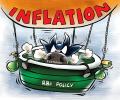
The RBI's Monetary Policy Committee brainstormed the impact of any future shocks on the inflation trajectory and stressed monitoring the cumulative effect of monetary policy actions over the past one year, which is still unfolding, revealed minutes of the rate-setting panel released on Thursday. The minutes of the meeting of the Monetary Policy Committee (MPC), headed by Reserve Bank Governor Shaktikanta Das, also indicated it would be premature to declare an end to the monetary tightening cycle, which started in May 2022 to check high inflation following the outbreak of the Russia-Ukraine war. The central bank, which effected six back-to-back hikes in the key short-term lending rate (repo) since May 2022 to check high inflation, decided to take a pause early this month.

While most analysts are expecting poor results from oil marketing companies (OMCs) in the first quarter of 2024-25 (Q1FY25) and even in the first half (H1) of FY25, GAIL (India) could be an outlier. Upstream producers, Oil and Natural Gas Corporation (ONGC) and Oil India (OIL) could do well due to strong crude and gas prices, but refiners are likely to see weak margins and the impact of frozen prices during the election period will also be negative.

The week's losses wiped out investor wealth worth Rs 18.43 trillion, with the total market capitalisation of BSE-listed firms now at Rs 441 trillion.

India's most valued company, Reliance Industries Ltd (RIL), reported a robust performance in the third quarter of the current financial year (Q3FY25), surpassing analyst expectations. This coupled with positive commentary by brokerages led to the stock of the oil-to-telecom conglomerate surging as much as 4.44 per cent to hit an intraday high of Rs 1,325.1. It settled at Rs 1,301.3 apiece, up 2.57 per cent.

A recession is unlikely in the APAC region in the coming year, although the area will face headwinds from higher interest rates and slower global trade growth, Moody's Analytics said on Thursday. In its analysis titled 'APAC Outlook: A Coming Downshift', Moody's said India is headed for slower growth next year more in line with its long-term potential. On the upside, inward investment and productivity gains in technology as well as in agriculture could accelerate growth.
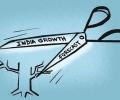
The International Monetary Fund (IMF) on Tuesday cut its projection of India's economic growth in 2022 to 6.8 per cent, as it joins other global agencies that have trimmed forecasts. The IMF had in July projected a gross domestic product (GDP) growth of 7.4 per cent for India in the fiscal year that started in April 2022. Even that forecast was lower than 8.2 per cent projected in January this year. India had grown at 8.7 per cent in 2021-22 fiscal (April 2021 to March 2022).

India will drive growth in the Asia-Pacific (Apac) region as the growth engine is likely to shift from China to South and Southeast Asia in the coming years, S&P Global Ratings said in a report on Tuesday. The rating agency's report projected China's growth to slow down to 4.6 per cent by 2026 from an estimated 5.4 per cent in 2023. India is likely to clock 7 per cent economic growth from 6.4 per cent estimated for 2023.

The airline industry is projected to register a net profit of $25.7 billion in 2024 as more normal growth is expected in both passenger and cargo segments, global grouping IATA said on Wednesday. For 2023, the net profit is estimated at $23.3 billion, significantly higher than the $9.8 billion projected by the International Air Transport Association (IATA) in June this year. IATA has more than 300 airlines as members.

Maruti Suzuki, Tata Motors, Mahindra & Mahindra, Hyundai and MG Motors are gearing up to introduce EVs in India.

'While most companies were bullish before the second wave of double-digit sales growth in FY22, that may not be the case now.'

Acutely conscious that he's left with less than four years to create his legacy, Trump is undoubtedly a man in a hurry, observes Ambassador M K Bhadrakumar.

After registering a net profit of Rs 25.1 crore in Q3FY25 and consolidated revenues growing by 7 per cent on a like-for-like basis, Siddharth Mittal, chief executive officer (CEO) and managing director, Biocon, told Sohini Das/Business Standard in a virtual interaction that local manufacturing in the US is a trade off between cost and qualifying to do business there.

A World Bank reports says the country has shown signs of "some softening" that could slow down the pace of growth slightly in 2011.
The Asian Development Bank (ADB) on Monday lowered India's growth forecast for the current fiscal to 5.6 per cent, from 7 per cent projected earlier, citing falling global demand and impact of delayed monsoon on agricultural production.

Once we break free of the idea that land is scarce, real estate is just a pile of bricks, steel, and glass. Any price surge will kick off a supply response, which kills off the possibility of sustained price appreciation, points out Ajay Shah.

The global lending agency also said that Brexit has resulted in global economic uncertainty.

The FMCG industry hopes for a revival in consumption growth in 2025 with some 'green shoots' already visible, after having a challenging year amid escalating input costs and a double-digit rise in food inflation, which ultimately slowed down the pace of the urban market growth in the second half of 2024. Soaring prices of commodities such as palm oil, coffee, cocoa and wheat forced FMCG players to go for a hike of 3 to 5 per cent or resort to shrinkflation by reducing pack sizes and grammage to retain attractive price points, fearing a volume loss.

In previews of Q2FY25 and beyond, industry analysts are expecting a turnaround for IT services. High teens earnings per share or EPS growth is expected for the next two-three financial years. The hopes are backed by deal wins of above $100 billion as at Q1FY25, up 16.6 per cent year-on-year ( Y-o-Y).

Trends in the global energy markets are crucial if India's growth outlook is to remain healthy. Prices for the Indian crude basket were averaging around $86.2 per barrel through Q1FY25 and then moderated to $84 in July and to $78-79 in August (so far). But global crude supply may outpace weak global demand in the short term.

India's economy continues to be robust, but downside risks such as rising crude oil prices, adverse weather conditions, and the global banking crisis outweigh the upside potential in gross domestic product (GDP) growth in the current financial year (FY24), the finance ministry said on Tuesday in its Monthly Economic Review for March. "We reiterate that downside risks to our official forecast of 6.5 per cent for real GDP growth in FY24 dominate upside risks," the review said. "Opec's surprise production cut has seen oil prices rise in April, off their lows of low-seventies per barrel in March.

Much of this spending increase is the result from projected gains in the value of foreign currencies versus the dollar, it said adding that in constant currency, spending growth in 2013 is expected to be 3.9 per cent.

The bull run in the Indian equity markets is intact, said analysts at Morgan Stanley in a recent note. They expect the S&P BSE Sensex to hit 80,000 levels by December 2023 in their bull-case scenario, to which they have assigned a 30 per cent probability. From the current level, this translates into an upside of nearly 29 per cent.

The listed information technology (IT) subsidiaries of engineering giant Larsen & Toubro (L&T), LTIMindtree (LTIM) and L&T Technology Services, have seen sharp upmoves over the past fortnight, with returns ranging from 14 to 18 per cent. Both have outperformed the peer index, the National Stock Exchange Nifty IT, which has gained about 8 per cent, while the benchmark Nifty 50 is up 4 per cent during this period.
The Reserve Bank of India on Friday raised the GDP growth projection for the current fiscal to 7 per cent from 6.5 per cent earlier on buoyant domestic demand and higher capacity utilisation in the manufacturing sector. Announcing the bi-monthly monetary policy, RBI Governor Shaktikanta Das, however, flagged protracted geopolitical turmoil and global economic fragmentation as risks to the growth outlook. The RBI kept interest rates unchanged at 6.5 per cent in Friday's monetary policy statement.

From the Sensex pack, Infosys tanked over 8 per cent after the company reported a lower-than-expected 11 per cent rise in net profit for the June quarter and delivered a shocker as it slashed its FY24 growth outlook to 1-3.5 per cent on delayed decision-making by clients amid global macro uncertainties. Hindustan Unilever, HCL Technologies, Wipro, and Tech Mahindra were the other major laggards. On the other hand, Larsen & Toubro rose the most by 3.88 per cent after it bagged an order of worth over Rs 7,000 crore from the bullet train project.

According to the TeamLease Employment Outlook Survey for the next six months (October 2014 - March 2015), global macroeconomic trends and domestic demand have put business and employment sentiment on a fast paced upward trajectory.
